Table of Contents
- 1. The Alarm Stage – ‘Oh, bloody hell!’
- 2. The Resistance Stage – ‘It’s fine. I’ve got this.’
- 3. The Exhaustion Stage – ‘Right. I’m done.’
- So, where does the body fit into all of this?
- HFR and Stage 2 – when the body has become used to tension
- HFR and Stage 3 – when the body says, ‘I’ve had enough’
- So, does HFR ‘deprogramme’ stress?
Stress itself isn’t our enemy. Quite the opposite. When you need to run away from a tiger, catch a flight, or realise five minutes before a meeting that it’s actually on Zoom and not, as you thought, ‘tomorrow’ – stress can be rather useful. The problem starts when the tiger doesn’t go away. Except instead of a tiger, we have work, our phones, bills, children, clients, traffic, messages and 47 tabs permanently open in our heads. When stress continues for too long, the body responds in stages. Traditionally, these are described as alarm, resistance and exhaustion.
Stress itself isn’t our enemy.
Quite the opposite. When you need to run away from a tiger, catch a flight, or realise five minutes before a meeting that it’s actually on Zoom and not, as you thought, ‘tomorrow’ – stress can be rather useful.
The problem starts when the tiger doesn’t go away.
Except instead of a tiger, we have work, our phones, bills, children, clients, traffic, messages and 47 tabs permanently open in our heads.
When stress continues for too long, the body responds in stages. Traditionally, these are described as alarm, resistance and exhaustion.
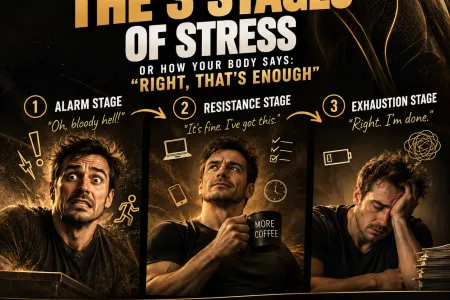
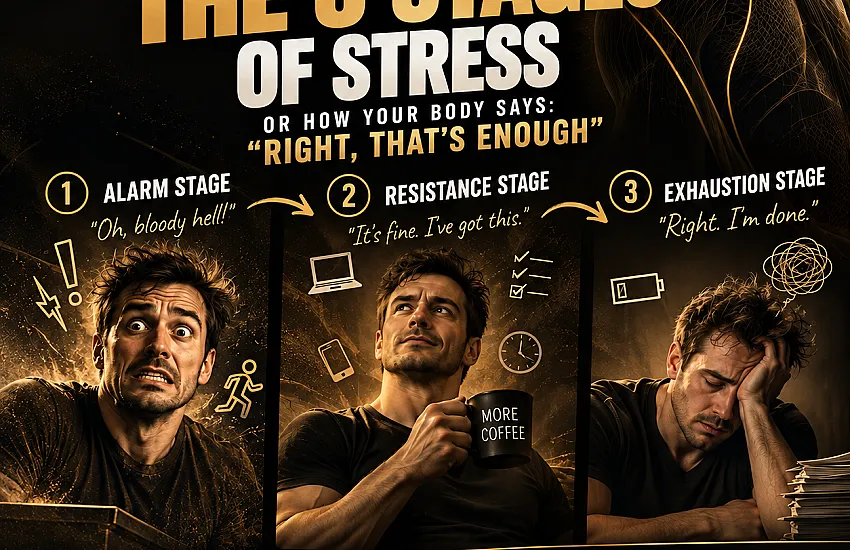
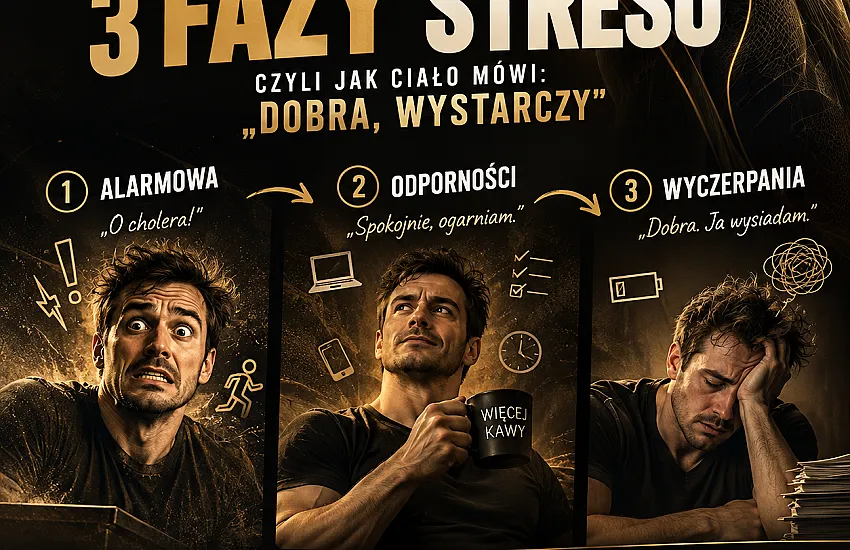
1. The Alarm Stage – ‘Oh, bloody hell!’
This is the moment the body recognises a potential threat.
The sympathetic nervous system puts its foot on the accelerator.
Your heart rate increases. Your breathing changes. Muscular tension rises. Your attention narrows towards whatever might be dangerous.
The body prepares for action.
And that’s a good thing.
The problem is that, as far as our nervous system is concerned, a ‘threat’ doesn’t necessarily have to be a bear running towards us.
Sometimes, one message is enough:
‘Hi, have you got a minute? We need to talk.’
And suddenly, your entire system is ready to fight for survival.
2. The Resistance Stage – ‘It’s fine. I’ve got this.’
The threat hasn’t disappeared, so the body tries to adapt.
From the outside, we may appear to be functioning perfectly well.
We work. We exercise. We answer our phones. We drink another coffee.
And we say:
‘I’m fine. There’s just quite a lot going on at the moment.’
Meanwhile, the body is still using its resources to maintain this heightened state of readiness.
Tension gradually starts to feel normal.
Breathing may become shallower. Recovery becomes more difficult. We may become less aware of the signals coming from our own body.
And this is where something rather interesting happens:
you can become so accustomed to tension that you stop noticing you’re tense.
‘Relax your shoulders.’
‘But I am relaxed.’
You’re not. 😉
3. The Exhaustion Stage – ‘Right. I’m done.’
If the pressure continues for too long, the body’s capacity to keep adapting can become increasingly strained.
At this point, it isn’t simply a matter of ‘trying harder’.
The body starts asking for recovery.
We may experience persistent tiredness, disturbed sleep, difficulty concentrating, increased irritability or a general sense of being overwhelmed.
And this is often when we do something completely logical:
we add even more.
More coffee.
More work.
A harder workout.
Another weekend dedicated to ‘catching up with everything’.
So, when the body says:
‘I need to slow down.’
We reply:
‘Brilliant. I’ll start CrossFit on Monday.’
So, where does the body fit into all of this?
Stress doesn’t exist only in our heads.
It can influence the way we breathe, muscular tension, movement, posture and the way the nervous system receives and interprets information coming from the body.
That is why, in Holistic Fascia Release, we don’t look at tension simply as:
‘That muscle is tight, so we need to loosen it.’
Sometimes tension is part of a much larger adaptive strategy within the body.
And this is where things become really interesting.
HFR and Stage 2 – when the body has become used to tension
During the resistance stage, a person may still function extremely well.
The problem is that the body can gradually become accustomed to an elevated level of tension.
What originally began as a response to stress starts to feel like ‘normal’.
HFR mobilisation offers the body a different experience.
Through calm, conscious work with the tissues, movement and body awareness, we help the client notice the difference between holding tension and letting go, while developing greater awareness of the signals coming from their body.
We don’t try to defeat tension with force.
We show the body that another option exists.
For the client, this may mean greater freedom of movement, an increased ability to release unnecessary tension, a deeper connection with bodily sensations and, importantly, becoming aware of tension earlier – before it has had the chance to build and become established.
Because it is very difficult to regulate something you cannot even feel.
HFR and Stage 3 – when the body says, ‘I’ve had enough’
During the exhaustion stage, adding another strong stimulus isn’t always what an already overloaded system needs.
That is why one of the fundamental principles of HFR is:
regulation before technique.
Rather than aggressively trying to ‘fix’ the body, we work in a way that allows the client to gradually reconnect with their body, experience a greater sense of safety and begin releasing unnecessary tension.
Mobilisation then becomes more than simply working with fascia.
It becomes an experience in which the body doesn’t constantly have to fight, react or remain prepared for the next threat.
For the client, this may mean:
less perceived tension and greater physical comfort,
more freedom and ease of movement,
an improved ability to move from activation towards rest,
earlier recognition of signs of overload,
greater body awareness,
and an opportunity to interrupt the familiar cycle of stress → tension → more tension.
So, does HFR ‘deprogramme’ stress?
We don’t delete stress from the body like an app from your phone. 😉
Stress is an important biological mechanism.
The aim is to help the body avoid remaining in a stress response when the threat is no longer present.
In Stage 2, we help clients become aware of and begin changing established patterns of tension.
In Stage 3, rather than adding another battle with the body, we create conditions that support regulation, body awareness and the gradual restoration of resources.
And that is why, in HFR, we don’t simply ask:
‘Where does it hurt?’
We also ask:
‘Why does the body still believe it needs to protect itself?’
Because when the body no longer needs its old protective strategy, change doesn’t always have to be forced.
It can become the body’s own choice.